Not literally of course - if i was, there would be no way i could get word to you guys via the interweb from underwater.
What i mean is i'm drowning in a sea of washing and its kind of annoying me ( although i can still make time to blog about it... ). Its annoying me because its there, and its annoying me because its making my house look untidy and i want to fold it and put it away.... but its like i cant. I keep looking at it and its frusturating me because i sooooooooo wanna be this SuperHousewife and i'm so motivated to do it - until it actually comes time to fold the damn clothes and then i'm all like " Flynn needs me " or " I need a nap " or " Hey, those cookies are calling my name ". I mean, its so bad - i'm all caught up with washing the clothes so its not like i have a mountain of dirty stuff lying around, its just that the overflowing baskets ( two and bit... ) of clean stuff is making a total brothel of my house. Seriously, when i get off this computer ( Lori, i have a problem.... ) i'm diving straight into the washing.
In other news, this time of the TMI variety - my son is still, ahem, " backed up ". Its been 16 days since he went naturally, without any " prompting " by a doctor, and the worry is starting to do my head in. Sometime he's in real pain and screams for 30 to 40 minutes at a time, and thats kind of stressful. We've tried: plain water, prune juice, pureed fruit, a teaspoon of paraffin oil, massage, warm baths and now we're on a steady diet of carrot/apple juice along with booby milks. And ...nothing. Not even a skiddy. Anyone got any other suggestions?
And finally - its voting time! Head over to Blog This! and vote for me in this weeks challenge!
PKNA issue 0/3 - Xadhoom! p. 19-27


NEXT
Go to start of this issue
Go to list
------------------------------------------------
Help support The Duck Avenger's efforts to make it to English-speaking countries - Superduck comics now available in America and the United Kingdom through Disney Digicomics!
Useful links: Here and here.
Overly long post explaining this: Here.
Even Artichokes Have Hearts....
Time for this weeks Blog This! challenge. See the bold for details:
What film has inspired you, changed you or the way you think, maybe put you on a new path?
So - for those of you who dont know, i like to consider myself a film buff. I dont have as much time these days as i would like, just to be able to sit and take in a new film. I've kind of slipped a little - in the year 2005 i watched over 200 films that i'd never seen before, now that number might be closer to 20 a year. Poo to that. The point i'm trying to make though is that this challenge was going to be hard for me. I've seen so many films, and had so many touch me in some way, that it was going to be difficult to pick just one. I had a few come to mind : " Hotel Rwanda ", " American History X ", " El Diarios De Motocicleta ", " Benny and Joon ". The one i settled on, however was.... " le Fabuluex Destin D'Amelie Poulain ". Or, just simply ( in English ) - " Amelie ".

What film has inspired you, changed you or the way you think, maybe put you on a new path?
So - for those of you who dont know, i like to consider myself a film buff. I dont have as much time these days as i would like, just to be able to sit and take in a new film. I've kind of slipped a little - in the year 2005 i watched over 200 films that i'd never seen before, now that number might be closer to 20 a year. Poo to that. The point i'm trying to make though is that this challenge was going to be hard for me. I've seen so many films, and had so many touch me in some way, that it was going to be difficult to pick just one. I had a few come to mind : " Hotel Rwanda ", " American History X ", " El Diarios De Motocicleta ", " Benny and Joon ". The one i settled on, however was.... " le Fabuluex Destin D'Amelie Poulain ". Or, just simply ( in English ) - " Amelie ".

I just simply adore this film. I love everything about it - the colour, the music, the whimsy, the beautiful Audrey Tatou. But their are two reasons i chose this film: because it made me believe that no matter how odd or weird or different you think you are, there is someone out there who is right for you and who will love you for the crazy that you are.... and it made me want to say " yes " more often.
See, Amelie is this gorgeous little Parisian women, who has a quirky father, works in a cute little cafe with an strange assortment of oddball characters and likes to pretend things in her head. She sends a garden gnome on a round the world trip, likes creme brulee and, like most women, she dreams about love. I related to her even though we had only half those things in common ( pretending, dreaming and cream brulee ). I liked that she was cute and quirky and kind of lived inside her own head a bit. I liked that she had a wicked sense of humour. And i liked that, when she had the opportunity, she took the bull by the horns and went after that perfect love she had been dreaming about. And she got it and all was right with the world. Amelie found Nino, and all because she was brave enough to say " yes " to life.
And what happened when I was brave enough to say " yes " to the opportunities that came my way, and stopped being so afraid of where " yes " may take me? I met a gorgeous man who is now my fiance and i have a beautiful baby boy. And all is right with the world.....
PKNA issue 0/3 - Xadhoom! p. 10-18


NEXT
Go to start of this issue
Go to list
------------------------------------------------
Help support The Duck Avenger's efforts to make it to English-speaking countries - Superduck comics now available in America and the United Kingdom through Disney Digicomics!
Useful links: Here and here.
Overly long post explaining this: Here.
I Ain't Got No Beiber Fever!
Oh.My.God.... argh! Justin Beiber is in Sydney! I think i'm going to pass out i love him so much!!!!

Ok, no, not really. I know who is but i'm so NOT in love with him. That song " Baby " drives me absolutely mental and the heartfelt yet super-cheesy lyrics just make me want to gag. The dude is 16, looks 12, and if he grew his hair much longer i could mistake him for a girl. ( As a side note, have you ever noticed how the most popular members of boy bands are always the girliest looking ? See Nick Carter of the Backstreet Boys and Mark What-his-face of Take That as evidence ). So why am i even talking about the Bieb?
Well, he's doing a press tour through Australia and was due to appear on a morning tv show today. After much spruiking - like 2 weeks of it - that he would be performing live on the show, and after a petition to have him perform live out on the street instead of in the studio.... the gig was cancelled. By police. Because of safety concerns. Apparently thousands of teenage girls had camped overnight in the middle of Sydney so they would be front row for his performance and, even hours before he arrived, some of them had passed out or had been crushed into barricades, and had to be taken away in ambulances. Some of the others wouldnt do as police instructed in regards to moving back from the stage/spreading out a little/quitening down so.... bam! Concert cancelled! Unlucky hysterical teenage girls!
What amuses me - aside from the fact that they braved the cold overnight, camping on concrete, and STILL missed out - is that i totally dont see the appeal of Justin Bieber. He's illicited a reaction like the Beatles and Elvis Presley did, but he is nowhere near - NOT EVEN CLOSE - to being as talented as either of those artists. He doesnt write his own songs, he doesnt play his own instruments and knows only the most basic of dance moves. Sure, he has that whole " nice boy " thing going for him - he's the boy you could take home to meet your mum ( you know, as opposed to, like, Eminem ) - but aside from that, i cannot fathom what made all those girls so completely ga ga.
I guess they just got themselves a bad case of so-called Beiber Fever - and if its contagious as it appeared on tv and i'm unlucky enough to catch it, promise me, dear readers, that one of you will find a way to kill me before it infects everyone i love?
Where Is The Young Mummy Love ?
So - i want to talk about the whole mummy sisterhood thing again ( apologies to those readers of mine who arent actually mothers - you're probably sick of hearing about it by now ). Seems like the whole sisterhood doesnt exactly extend past the " Baby Boomer " generation, or at least it hasnt in my experience. Let me explain:
My mothers group gets together on a Thursday morning, around 10am. We go to a cafe ( one that had enough to room to accomodate at least 10 women and, thusly, 10 prams ) and have a bit of a coffee and much conversation. Some of it is trivial - " Did you see such-an-such a movie ? " - but, of course, much of it revolves around our babies and our mothering experiences. Its nice to be able to share with other new mums, women that havent been through it before and have just as little clue as i do. We arent overly raucous however when your in a group of 10 or more sometimes you do have to speak up a little so that you can be heard across, or down, the table. This hasnt been a problem before - at 10am on a Thursday morning most cafes around here are pretty empty ( which is why our prams fit! ) or very quiet at the least. Not yesterday, however - yesterday we got asked to stop talking.
We had two babies having their " half birthday " ( ie. they were 6 months old ) so we had a little cake for them. Their mothers, naturally, were trying to figure out which of the bubs was actually older so started along the lines of " Oh, i went into labour the day before but he didnt arrive until.... ". Now, mind you, we didnt go into intimate, gory details - we may at some point, but thus far the sharing of labour stories hasnt much gone past what drugs we used and how long it all went. So, anyhoo, yesterday we're trying to figure out who was born first..... and one of the mums said " Man, my water broke then wooosh...and it was all on! ". Thats almost word for word mind you - no more, no less. Then, from a table behind us we hear - " Umm, ladies, thats enough ! ". We all look over and this old lady, sitting with another old lady and old man, goes " Really - i've been there and done that and now i'm trying to enjoy my morning tea ". What the?!?
Seriously - nothing more shocking then " my water broke... " and this old bird was asking us, politely, to shut up. How freaking rude! We have every right to gather and discuss that type of thing, and we have every right to en joy that type of discussion with OUR morning tea. Lord, nobody mentioned vaginas, or stitches, or dialation or anything vaguely " rude".... just water breaking and what time contractions started. I'd hate to see what her reaction would have been had one of us had to pop a boob out to feed our child - she might have had a bloody fit! Just because she wouldnt have had the same kind of group for support and advice in her day, or had the chance to discuss birth stories or bodily changes with anyone ( not even her mother and/or sister ) doesnt mean we shouldnt be able to. She should be proud, and happy, that women of the generation she would have raised worked hard to allow us the f reedom to break taboos. But no - she just wanted us to stop our conversation so she could enjoy a cup of tea.
So boo hoo to you, you old bag! Perhaps next time when you see a gathering of young women with babies and prams you'll be smart enough to figure out its a mothers group - and you can bugger off somewhere else for your precious morning tea!
My mothers group gets together on a Thursday morning, around 10am. We go to a cafe ( one that had enough to room to accomodate at least 10 women and, thusly, 10 prams ) and have a bit of a coffee and much conversation. Some of it is trivial - " Did you see such-an-such a movie ? " - but, of course, much of it revolves around our babies and our mothering experiences. Its nice to be able to share with other new mums, women that havent been through it before and have just as little clue as i do. We arent overly raucous however when your in a group of 10 or more sometimes you do have to speak up a little so that you can be heard across, or down, the table. This hasnt been a problem before - at 10am on a Thursday morning most cafes around here are pretty empty ( which is why our prams fit! ) or very quiet at the least. Not yesterday, however - yesterday we got asked to stop talking.
We had two babies having their " half birthday " ( ie. they were 6 months old ) so we had a little cake for them. Their mothers, naturally, were trying to figure out which of the bubs was actually older so started along the lines of " Oh, i went into labour the day before but he didnt arrive until.... ". Now, mind you, we didnt go into intimate, gory details - we may at some point, but thus far the sharing of labour stories hasnt much gone past what drugs we used and how long it all went. So, anyhoo, yesterday we're trying to figure out who was born first..... and one of the mums said " Man, my water broke then wooosh...and it was all on! ". Thats almost word for word mind you - no more, no less. Then, from a table behind us we hear - " Umm, ladies, thats enough ! ". We all look over and this old lady, sitting with another old lady and old man, goes " Really - i've been there and done that and now i'm trying to enjoy my morning tea ". What the?!?
Seriously - nothing more shocking then " my water broke... " and this old bird was asking us, politely, to shut up. How freaking rude! We have every right to gather and discuss that type of thing, and we have every right to en joy that type of discussion with OUR morning tea. Lord, nobody mentioned vaginas, or stitches, or dialation or anything vaguely " rude".... just water breaking and what time contractions started. I'd hate to see what her reaction would have been had one of us had to pop a boob out to feed our child - she might have had a bloody fit! Just because she wouldnt have had the same kind of group for support and advice in her day, or had the chance to discuss birth stories or bodily changes with anyone ( not even her mother and/or sister ) doesnt mean we shouldnt be able to. She should be proud, and happy, that women of the generation she would have raised worked hard to allow us the f reedom to break taboos. But no - she just wanted us to stop our conversation so she could enjoy a cup of tea.
So boo hoo to you, you old bag! Perhaps next time when you see a gathering of young women with babies and prams you'll be smart enough to figure out its a mothers group - and you can bugger off somewhere else for your precious morning tea!
PKNA issue 0/3 - Xadhoom! p. 1-9
These pages have been removed at the request of Disney. However, you can read on from here:
NEXT
Previous issue
Go to list
And, hey, if you're enjoying these comics, feel free to help us promote them. Spread the word on forums, comic related sites, whereever you think people might be interested. Any help is much appreciated!
------------------------------------------------
Help support The Duck Avenger's efforts to make it to English-speaking countries - Superduck comics now available in America and the United Kingdom through Disney Digicomics!
Useful links: Here and here.
Overly long post explaining this: Here.
NEXT
Previous issue
Go to list
And, hey, if you're enjoying these comics, feel free to help us promote them. Spread the word on forums, comic related sites, whereever you think people might be interested. Any help is much appreciated!
------------------------------------------------
Help support The Duck Avenger's efforts to make it to English-speaking countries - Superduck comics now available in America and the United Kingdom through Disney Digicomics!
Useful links: Here and here.
Overly long post explaining this: Here.
An Un-Mushy Update
This one is a little TMI, unless your a mumma, in which case its just a normal thing for you.
As i previously posted, my little Flynn started on " solids " last week. However, we've backed off the mush for a few days because, ahem, the little dude is " backed up". If you know what i mean. And if you dont - it means he hasnt pooped in over 6 days now. I knew that introducing solids messes with their little digestive systems for a while, and i was expected a little break in poop proceedings - but 6 days ? Holy schmoly! I've taken him to the doctor and he's been on little baby laxative drops and prune juice for 3 days but still nothing. I feel bad because i'm the one who's fed him the stuff thats blocked him up - my only consolation is he doesnt really seem to be in any pain, except after a feed. After a feed when his tummy is full he goes all red in the face and has a big. old, screaming cry. Mama doesnt like listening to that. It makes me feel bad. He had his 4 month vaccination needles today and i asked the nurse about his " problem " and she said its completely normal, just keep up the drops and the juice, and he has to pooh eventually.
We all do, right?
( Oh, and on an unrelated note, if you havent voted for me yet, head to Blog This! and vote for me in this week challenge.... voting ends tonight! )
As i previously posted, my little Flynn started on " solids " last week. However, we've backed off the mush for a few days because, ahem, the little dude is " backed up". If you know what i mean. And if you dont - it means he hasnt pooped in over 6 days now. I knew that introducing solids messes with their little digestive systems for a while, and i was expected a little break in poop proceedings - but 6 days ? Holy schmoly! I've taken him to the doctor and he's been on little baby laxative drops and prune juice for 3 days but still nothing. I feel bad because i'm the one who's fed him the stuff thats blocked him up - my only consolation is he doesnt really seem to be in any pain, except after a feed. After a feed when his tummy is full he goes all red in the face and has a big. old, screaming cry. Mama doesnt like listening to that. It makes me feel bad. He had his 4 month vaccination needles today and i asked the nurse about his " problem " and she said its completely normal, just keep up the drops and the juice, and he has to pooh eventually.
We all do, right?
( Oh, and on an unrelated note, if you havent voted for me yet, head to Blog This! and vote for me in this week challenge.... voting ends tonight! )
PKNA issue 0/2 - The Winds of Time p. 51-60


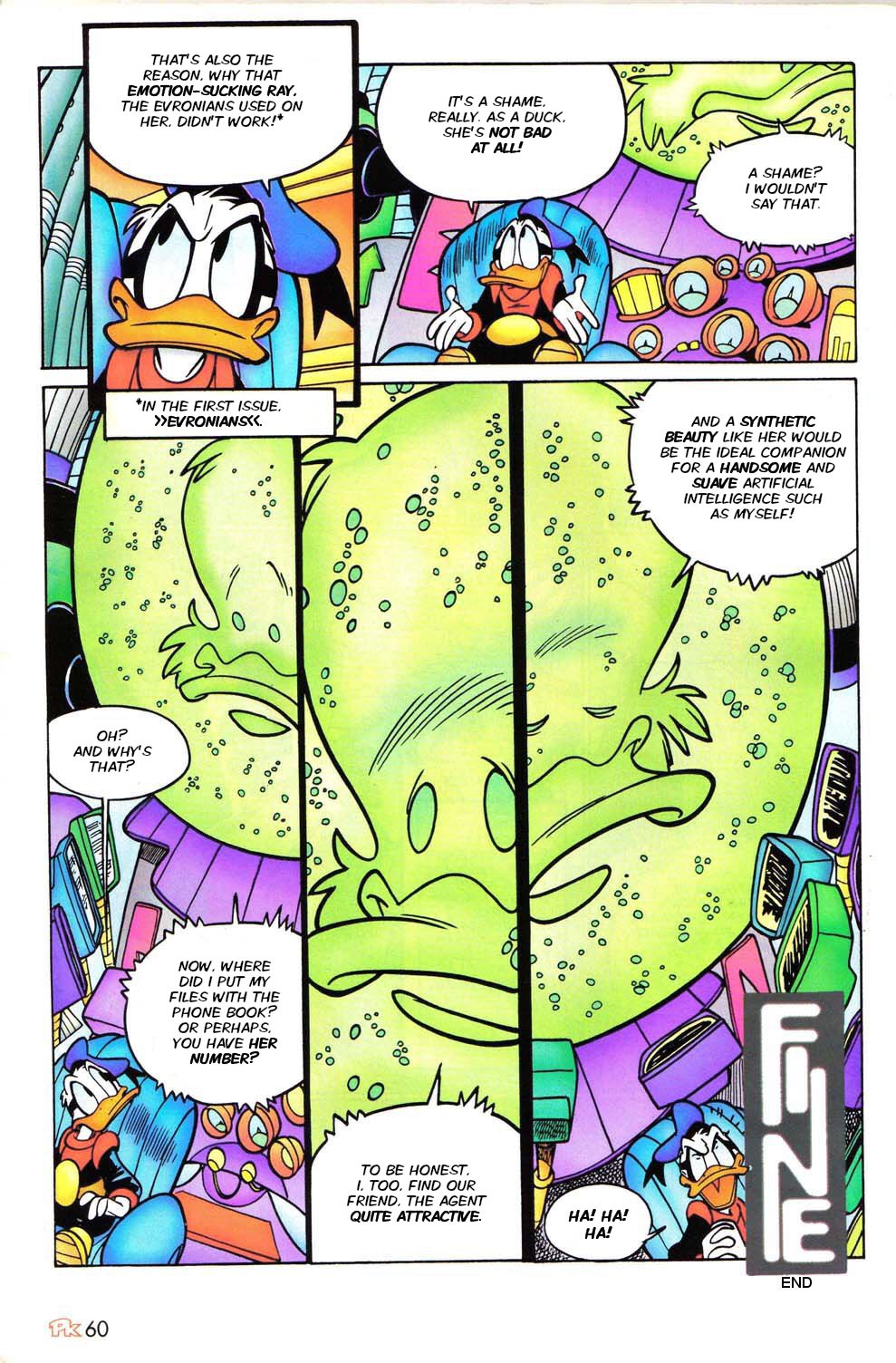
End.
Download - MegaUpload
Next:

Soon, the dance begins!
GO TO NEXT ISSUE
Go to start of this issue.
Go to list
Seeing as this was the last of the previously translated comics, this will be the last Wednesday update for a while. We now return to our good old 'Mondays and Fridays' update schedule.
From now on, the goal will be to have one complete issue uploaded every four weeks. (Still divided into bite-sized chunks, of course.)
Next issue up is PKNA 0/3, 'Xadhoom'. The first pages will go up soon, but because of how fast the two latest issues have been uploaded, there's a certain risk that we won't have the new issue ready in time.
Hopefully we'll get the last details sorted quickly, but otherwise, we MAY have to skip this Friday's update. Of course, even if that happens, we'll still be coming back strong on Monday with the new issue.
------------------------------------------------
Help support The Duck Avenger's efforts to make it to English-speaking countries - Superduck comics now available in America and the United Kingdom through Disney Digicomics!
Useful links: Here and here.
Overly long post explaining this: Here.
From One Befuddled Brain To Another
Blog This! challenge time again:
This week we'd like all of blog this members to seek out another. One you've never visited, one you don't follow. One you admire, find interest in. Write about it on your blog and 'review' it, gush about it, or re-post one of their articles with your commentary. Be nice! Leave a comment and a link for them to know you've done so.
So i read this weeks challenge with interest - go out and find myself some new blogs to read huh ? Search the members list and discover great new blogs to read and love and comment on ? Yea, ok, i can do that. Piece of cake i thought. But, to be honest with you, it wasnt all that easy. I thought i would just click on five random blogs ( scroll down the page with my eyes shut and click on which ever link the cursor rested on ... ) and i would have a hard time choosing the best of them to write my post about. But i tried that and i didnt fall under the spell of any of that first five. I tried it again - i didnt melt for any of the second five either. Its not to say that those 10 blogs that i perused were " bad " - just that the blog subject or the writing style didnt jump out and grab me. I'm a bit fussy with my blog reading i think - your style of writing really has to read well, really needs to jump out at me, other wise i'm gonna be bored. I'm a self confessed Yoga Nazi, so maybe i'm a Blog Nazi too, i dont know. What i'm saying is there is a whole bunch of good Blog This!-ers out there, some of them just dont necessarily speak to me. However, after much blog surfing, i stumbled upon ...
Brea's Befuddled Brain.
No, i did not trip over and ACTUAL brain, thats the name of Brea's blog. What is funny is that when i saw the picture of Brea on her blog i thought she looked familiar... and then i realised she was a follower of MY blog and i'd never had a look at hers. Bad, bad, blog manners Amy! What is also funny is that the most recent post when i first went to her blog ( i have been back subsequently ) was regarding the Ultimate Blog Party 2010 and she'd actually written a little introduction/welcome to her blog .... which made my job so much easier! And i like the way the lady writes - seems she shares my slightly sarcastic, kinda kooky sense of humour - which makes me wanna stick around on her blog. Hell, i even pressed the follow button and contributed to her goal of achieving 100 followers by her next birthday. Ambitious.Witness this passage, direct from Brea's post:
There's been a Party happening right under my nose for the past week and I've stubbornly resisted attending.
It's not because I'm shy or anything, nothing as glamorous as that. Truthfully? It's because I can't be bothered shaving my legs.
Also:
* We both have pierced belly buttons and tattoos
* We're both mumma's
* She just recently dyed her hair a burgundy/red colour and i'm tossing up doing the same
* She's uses the word " befuddled " which, frankly, i think is waaaaay under-used.
* She said ( above ) that she didnt attend the Ultimate Blog Party 2010 because " I can't be bothered shaving my legs ". Tongue in cheek of course because the Blog Party was an online event, but it made me cack because i'm one of these chickies that will wear long pants on a warm day because i couldnt be arsed getting the razor out ( like today, for example ).
And so, by taking part in this weeks challenge, i've reached out and virtually shook hands with Brea. Maybe you could too - pop over and do her a favour, press her Follow button and help her reach her goal!
This week we'd like all of blog this members to seek out another. One you've never visited, one you don't follow. One you admire, find interest in. Write about it on your blog and 'review' it, gush about it, or re-post one of their articles with your commentary. Be nice! Leave a comment and a link for them to know you've done so.
So i read this weeks challenge with interest - go out and find myself some new blogs to read huh ? Search the members list and discover great new blogs to read and love and comment on ? Yea, ok, i can do that. Piece of cake i thought. But, to be honest with you, it wasnt all that easy. I thought i would just click on five random blogs ( scroll down the page with my eyes shut and click on which ever link the cursor rested on ... ) and i would have a hard time choosing the best of them to write my post about. But i tried that and i didnt fall under the spell of any of that first five. I tried it again - i didnt melt for any of the second five either. Its not to say that those 10 blogs that i perused were " bad " - just that the blog subject or the writing style didnt jump out and grab me. I'm a bit fussy with my blog reading i think - your style of writing really has to read well, really needs to jump out at me, other wise i'm gonna be bored. I'm a self confessed Yoga Nazi, so maybe i'm a Blog Nazi too, i dont know. What i'm saying is there is a whole bunch of good Blog This!-ers out there, some of them just dont necessarily speak to me. However, after much blog surfing, i stumbled upon ...
Brea's Befuddled Brain.
No, i did not trip over and ACTUAL brain, thats the name of Brea's blog. What is funny is that when i saw the picture of Brea on her blog i thought she looked familiar... and then i realised she was a follower of MY blog and i'd never had a look at hers. Bad, bad, blog manners Amy! What is also funny is that the most recent post when i first went to her blog ( i have been back subsequently ) was regarding the Ultimate Blog Party 2010 and she'd actually written a little introduction/welcome to her blog .... which made my job so much easier! And i like the way the lady writes - seems she shares my slightly sarcastic, kinda kooky sense of humour - which makes me wanna stick around on her blog. Hell, i even pressed the follow button and contributed to her goal of achieving 100 followers by her next birthday. Ambitious.Witness this passage, direct from Brea's post:
There's been a Party happening right under my nose for the past week and I've stubbornly resisted attending.
It's not because I'm shy or anything, nothing as glamorous as that. Truthfully? It's because I can't be bothered shaving my legs.
Also:
* We both have pierced belly buttons and tattoos
* We're both mumma's
* She just recently dyed her hair a burgundy/red colour and i'm tossing up doing the same
* She's uses the word " befuddled " which, frankly, i think is waaaaay under-used.
* She said ( above ) that she didnt attend the Ultimate Blog Party 2010 because " I can't be bothered shaving my legs ". Tongue in cheek of course because the Blog Party was an online event, but it made me cack because i'm one of these chickies that will wear long pants on a warm day because i couldnt be arsed getting the razor out ( like today, for example ).
And so, by taking part in this weeks challenge, i've reached out and virtually shook hands with Brea. Maybe you could too - pop over and do her a favour, press her Follow button and help her reach her goal!
PKNA issue 0/2 - The Winds of Time p. 41-50


NEXT
Go to start of this issue.
Go to list
------------------------------------------------
Help support The Duck Avenger's efforts to make it to English-speaking countries - Superduck comics now available in America and the United Kingdom through Disney Digicomics!
Useful links: Here and here.
Overly long post explaining this: Here.
" It's In Fashion " Is NOT An Excuse
Oh yea, i'm up on my fashion soapbox again. Lets face it - i'm no style icon - but i know what i like and i know what is not flattering. Which is, unfortunately, not the case with everybody else. Some people know what they like but what they like is bleh; some people think that just because something is in fashion means they should wear it, regardless of what it actually looks like on them; and some people have no clue, dont want one, and wear whatever they feel like, regardless of current fashions and/or flattering-ness ( which isnt a word, but who cares ? ).
I'm all for individuality, so if you're one of these totally awesome people that can shop at flea markets and op-shops and throw together the most gorgeous, vintage, rocking ensemble without the slightest hint of effort, than good for you. What i'm not for is slavery to fashion, and heinous crimes against said fashion - you shouldnt pander at the fashion alter, but nor should you ignore it so much that what you pass as an " outfit " could burn someone elses retinas. I'm also " anti " some apparently fashionable things, or fashion trends. My biggest bug bare? Leggings.

I'm all for individuality, so if you're one of these totally awesome people that can shop at flea markets and op-shops and throw together the most gorgeous, vintage, rocking ensemble without the slightest hint of effort, than good for you. What i'm not for is slavery to fashion, and heinous crimes against said fashion - you shouldnt pander at the fashion alter, but nor should you ignore it so much that what you pass as an " outfit " could burn someone elses retinas. I'm also " anti " some apparently fashionable things, or fashion trends. My biggest bug bare? Leggings.
I've said it once, i'll say it again, as loud as the blog medium will let me: LEGGINGS ARE NOT PANTS. Leggings ( or tights, whichever you prefer ) are not acceptable as an alternative to pants. They are not interchangeable. I'm ok with wearing leggings are under skirts and dresses - hell, i'm even alright with leggings under shorts ( although its not entirely flattering ) - but what i am not ok with is leggings, on their ownsome, worn as one would wear a pair of pants. Witness:

Stolen from www.domestica.typepad.com
You will notice that these are leggings - NOT pants. I can see every contour of this girls body - hell, she's naked enough to be able to rest the support pole between her butt cheeks. Pants would contain hardy fabric which would make this little disappearing trick a little, well, trickier. Also - notice that poor old Pop there does not know where to look. Probably because if he looks down he will not only be able to count the individual dimples on this girls thighs, but he'll also be able to tell how good a job her waxer does. Seriously, a little mystery would be so much more attractive. AS WOULD SOME PANTS!!
My other pet fashion hate the moment ? Boys in tight jeans. Tight jeans are awesome for legendary 80's rockstars ( see, please Bon Jovi, Jon and Micheals, Brett ). They are not so awesome for every pimply, teenage skate rat i see skulking around the mall. Especially when the tight pants are accompanied by a visible underwear waistband. I dont wanna know what brand of underwear your mum buys you, and i dont want to get the hint of your adolscent plumbers cleavage. I feel like a grandma but.... for God's sake, pull your bloody pants up!
Ok, rant over. I just had to get that off my chest before i go through my wardrobe and figure what still fits my post-pregnancy body ( baby boobs are an issue... ) and therefore prepare myself for what fashions may confront me at Tar-jay and Big W ( oh yea, unpaid maternity leave is also a wardrobe issue ... ).
You Gotta Be In It To Win It
The lottery that is. And i'm not usually - i might buy a lottery ticket once or twice a year, so its highly doubtful that i'll ever win the big bucks but, for the sake of a blog post, lets just pretend that i did win big. Say $50 million dollars big. What would i do with it ? ( NOTE: i totally stole this very simple idea from Erin @ Motherhood Y'all ).
 #1: Umm, boring - i'd pay off my debts. Which, for me, means my mortgage, my car loan and a couple of hundred dollars on a credit card. I'd also pay Mickey J's debt and our immediate families. Way to get in the good books right ?
#2: Pay for my wedding and honeymoon - we still havent set an official date yet but Mick and I plan on getting married sometime around September or October next year. My parents have a bit of money set aside to pay for it all but i'd much rather pay for it myself. Either way, whether we had $1000, $10 000 or $1 million dollars, it wont be an extravagant affair. We're just not that kind of people. Beautiful dress ? Yep. Pretty location? Yep. Good food? Yep. Should it cost the price of a new car ? Umm - nup.
#3: Buy a new house - for my little family ( we currently live in a two bedroom duplex that i - or the bank - own ) and one for each of our immediate family members. That way, after having already paid off their debts, they could have a new home to live in and one as an investment property to earn them money. Tricky....
#4: Set some aside for my children - well, i only have one at the moment but i will have more in the future ( i'm like 99% sure ). So i'd set aside a big lump sum as a trust fund, say one that couldnt be touched til they were 25. I would hope by then that they'd figured out their priorities in life and then they could put the money to good use. You know, instead of blowing $50 000 on booze and parties and sexual liasions. Which is all fun, just not what me as Mum would want the money spent.
#5: Investment - i dont really know how the investment market works so i'd have to get some help with that, but i wouldnt wanna blow all my moolah on junk. I'd be smart enough to put some into stocks, or into the property market ( or, you know, whatever ) so that i could make money off of my money. I don't mean for that to sound greedy, but you'd do that too right?
#6: Give to charity - maybe a $100 000 or so. I'd give to a few different causes : Westmead Childrens Hospital in Sydney, Careflight, The Jane McGrath Foundation.... things like that. I might give some to a foreign aid charity, but only after i'd fixed up some Australian interests first. I'm not against foreign aid ( i've sponsored a child through World Vision for 9 years... ) i just would like to give to a charity this is going to help in my community first, thats all.
#7: ( Lucky last ) Living allowance - i'd quit my job so i could be a SAHM for a while ( until Flynn and any subsequent children were at school ) so i'd need to allot some money to the day to day running of our house. Maybe $80 000 a year? Thats more than what we live off now but its not flashy - enough to cover bills and neccessities but with a little extra for luxuries and holidays. Yep, that sounds about right.
So how about you guys? Where would your Lotto winnings go ? ( Oooh, and speaking of winning things, head over to Blog This! and vote for me in this weeks poll. Please!?! )

#2: Pay for my wedding and honeymoon - we still havent set an official date yet but Mick and I plan on getting married sometime around September or October next year. My parents have a bit of money set aside to pay for it all but i'd much rather pay for it myself. Either way, whether we had $1000, $10 000 or $1 million dollars, it wont be an extravagant affair. We're just not that kind of people. Beautiful dress ? Yep. Pretty location? Yep. Good food? Yep. Should it cost the price of a new car ? Umm - nup.
#3: Buy a new house - for my little family ( we currently live in a two bedroom duplex that i - or the bank - own ) and one for each of our immediate family members. That way, after having already paid off their debts, they could have a new home to live in and one as an investment property to earn them money. Tricky....
#4: Set some aside for my children - well, i only have one at the moment but i will have more in the future ( i'm like 99% sure ). So i'd set aside a big lump sum as a trust fund, say one that couldnt be touched til they were 25. I would hope by then that they'd figured out their priorities in life and then they could put the money to good use. You know, instead of blowing $50 000 on booze and parties and sexual liasions. Which is all fun, just not what me as Mum would want the money spent.
#5: Investment - i dont really know how the investment market works so i'd have to get some help with that, but i wouldnt wanna blow all my moolah on junk. I'd be smart enough to put some into stocks, or into the property market ( or, you know, whatever ) so that i could make money off of my money. I don't mean for that to sound greedy, but you'd do that too right?
#6: Give to charity - maybe a $100 000 or so. I'd give to a few different causes : Westmead Childrens Hospital in Sydney, Careflight, The Jane McGrath Foundation.... things like that. I might give some to a foreign aid charity, but only after i'd fixed up some Australian interests first. I'm not against foreign aid ( i've sponsored a child through World Vision for 9 years... ) i just would like to give to a charity this is going to help in my community first, thats all.
#7: ( Lucky last ) Living allowance - i'd quit my job so i could be a SAHM for a while ( until Flynn and any subsequent children were at school ) so i'd need to allot some money to the day to day running of our house. Maybe $80 000 a year? Thats more than what we live off now but its not flashy - enough to cover bills and neccessities but with a little extra for luxuries and holidays. Yep, that sounds about right.
So how about you guys? Where would your Lotto winnings go ? ( Oooh, and speaking of winning things, head over to Blog This! and vote for me in this weeks poll. Please!?! )
PKNA issue 0/2 - The Winds of Time p. 31-40


NEXT
Go to start of this issue.
Go to list
------------------------------------------------
Help support The Duck Avenger's efforts to make it to English-speaking countries - Superduck comics now available in America and the United Kingdom through Disney Digicomics!
Useful links: Here and here.
Overly long post explaining this: Here.
Subscribe to:
Posts (Atom)


